Background:
The Queen’s Gallantry Medal (QGM) was introduced in June 1974 as an award to civilians for “acts of exemplary bravery” at a level below that of the George Medal. The QGM may also awarded to military personnel for acts for which military honours would not normally be granted, such as acts of exemplary bravery not in the presence of the enemy. The QGM replaced the Order of the British Empire and the British Empire Medal when awarded for Gallantry. The award was available posthumously from 1977. Over 1,000 awards of the QGM have been made since its introduction in 1974. The name of the recipient is impressed around the rim of the medal.
Since the accession of King Charles III in 2022, the Queen’s Gallantry Medal has been renamed the King’s Gallantry Medal (KGM). The first awards of the King’s Gallantry Medal were announced in the London Gazette on 14 May 2024.
Design:
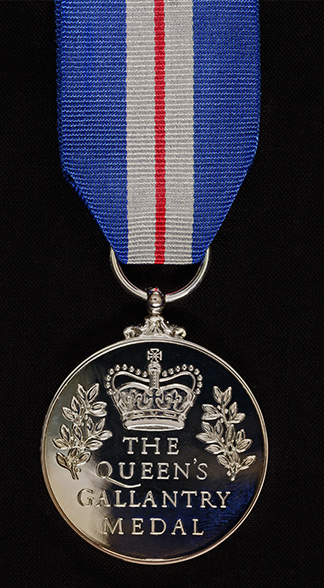
The medal is silver and circular in shape being 36 mm in diameter. The obverse shows a crowned portrait of King Charles III and is inscribed “CHARLES III DEI GRATIA REX FID DEF”. The reverse now bears the image of the Tudor Crown above the words ‘THE KING’S GALLANTRY MEDAL’ in four lines, flanked by laurel sprigs. The ribbon is of three equal vertical stripes of garter blue, pearl grey and garter blue with a narrow rose pink stripe in the centre.
Bars:
A silver bar, ornamented with laurel leaves, will be awarded to holders of the KGM who perform a further act of such bravery which would have merited award of the QGM or KGM. When the ribbon alone is worn, a silver rosette worn centrally on the ribbon denotes an award of a Bar. There have been 19 double awards of the QGM, the last awards of Bars were made in 2008 to Captain Heakin QGM RLC and Captain Strafford QGM RLC for actions in Iraq.