Background:
The British Empire Medal was instituted in June 1917 as part of the Order of the British Empire and met the pressing need to honour the wide ranging war services of large numbers of civilians, especially in the voluntary sectors. The medal could be awarded in recognition of either meritorious civil or military service or for gallantry at the third level. The BEM for Gallantry could not be awarded posthumously and was eventually replaced in 1974 with the Queen’s Gallantry Medal (QGM). Recipients are entitled to use the post-nominal letters “BEM“. The medal was discontinued for award to UK subjects between 1993 and 2012 although it continued to be awarded in some Commonwealth realms during that time. To coincide with the Queen’s Diamond Jubilee celebrations, the British Empire Medal was reinstituted for subjects of the United Kingdom in June 2012 although only in the civil division.
Design:
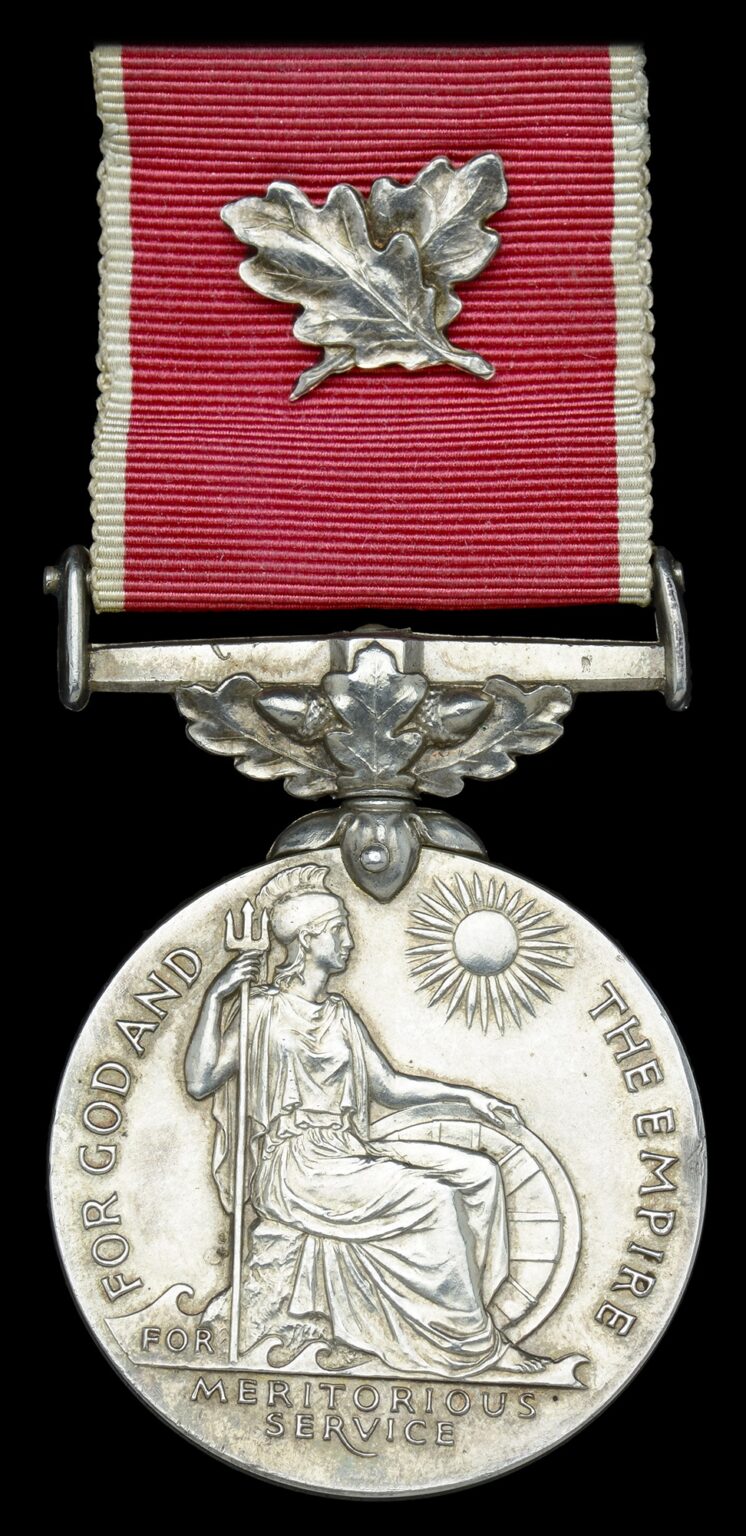
The silver medal bears on the obverse, the seated profile of Britannia, robed and helmeted, sitting facing right upon a rock, which is partly obscured by drapery, holding a trident in her right hand and supporting a Union shield with her left. In the upper right of the design the sun shines and at the base, waves lap around Britannia’s feet. The image is surrounded by the legend FOR GOD AND THE EMPIRE and at the base is engraved FOR MERITORIOUS SERVICE. The reverse displays the Sovereign’s cypher EIIR surmounted by a crown surrounded by four heraldic lions. At the base is the legend INSTITUTED BY KING GEORGE V. The medal hangs from a straight bar, the central pin is adorned with oak leaf and acorn supports. The ribbon is rose-pink with pearl-grey edges, with the addition of a pearl-grey central stripe to denote those awarded the medal in the military division. The colours match those used for other classes of the Order of the British Empire. When awarded for gallantry, the recipient wears a silver oak leaf emblem centrally on the ribbon. When the ribbon only is worn the emblem is worn in miniature.